Showing posts with label falda folklorica. Show all posts

Thursday, January 22, 2015

Holding your clothes in my hands...

The end of 2014 was so full and inspiring. We returned to the U.S., gave a workshop at a university, schemed about future plans, and held the first dance performance in a skirt made from migrants' clothes.

We were so honored and had so much FUN working with the wonderful people at Cal State Channel Islands (CSUCI) to put on a workshop for their students in conjunction with a campus visit by the remarkable author Luis Alberto Urrea (who writes on growing up in Tijuana and is basically a stand-up comedian).

We got to see one of the skirts in action for the first time, as she was danced in by the student Ballet Folklorico group for the entire CSUCI campus. This skirt is one of Las Dos Hermanas, two Mexican folk dance skirts made from migrants' clothing.


Goyo Coyolicatzi Cortes, of the Ballet Folklorico de Channel Islands, performs in the "American Sister" falda.
The student-led Ballet Folklorico de CI choreographed a dance for the falda that featured 4 different regional styles of dance and costume from Mexico: from Sinaloa, Jalisco, and Veracruz. Such an amazing performance!

We also held a workshop at CSUCI. 30 students came together to discuss border crossings, the structural causes of immigration, and of course, to work with the clothes collected from migrants' trails in the desert.

In all of the Mending Patriotism workshops, the hope is to give people the chance to encounter a border. We sit together, we raise questions, and we tell our stories. Not everyone at first thinks they have a relationship with the border. For some -- who have never seen the US-Mexico border first-hand -- it is an opportunity to touch the physical evidence of the journeys that take place across the border and continue within the US.

At the CSUCI workshop, the students did some writing to reflect on how it felt to encounter these clothes. They touched on themes of human rights, being divided from family members, bafflement at how these clothes came to be where they were found, and messages of alliance & support.

Here are some excerpts from their responses to the prompt "Holding your clothes in my hands..."

***
Here I hold a beige bra. It looks like it has been in the desert for such a long time. Threads, holes, dirt and cuts all over it. This could belong to a mother, a sister, aunt. Who is dead or maybe alive nobody really knows. This drape left behind symbolizes a dream, a dream to make it to the land that would bring them a better future. Could this woman be a victim of rape? Why was her bra left behind? We don’t know but we do know that her biggest goal was to make it across the desert. This item symbolizes hope, courage, fear, strength, obstacles, sadness, crying, thirst, hunger, tiredness, feelings of being lost, it represents someone who hoped to one day find better opportunities, it represents a long journey that may or may not have been accomplished.

***


I wish I could take in your family of three
or do you even have children that will always be a mystery to me
I look at your green shirt
But where are you? Somewhere in the dirt?
You should be home after work
with your family not lost in the desert

Holding your clothes in my hand I am lost for words

***


Al tener su ropa en mis manos siento su amor, su desesperacion, su fuerza, sus ganas, y sobre todo siento su esperanza. Entiendo que su camino no ha sido nada facil, que esta decision no se tomo libremente, ni de un dia para otro. Talvez esta manana al partir de su casa, su esposa, su madre, su abuela o su hija fue la que le puso la bufanda. Talvez la bufanda la uso para proteger a su bebe. Quiero que sepa que sus motivos de cruzar, los que hayan sido no seran olvidados...y usted donde quiera que se encuentre no sera olvidada...la tierra que penetra la bufanda es nuestra de todo humano, no es mia, ni de el o de ella, es del universo. Este universo es de todos. Yo se que donde quiera que usted se encuentre a llegado a tener la felicidad que anela.

***

Looking down and seeing that tattered -- whatever it was-- a shirt, pants, handkerchief -- my stomach ached. It dropped so low I never thought I would get it back. The reds and whites of the cloth stood out to me like blood on a canvas. A canvas of your life. Your blood. Your cloth, yet not you. My stomach in knots and my mind in a daze, going back and forth over a dozen scenarios. Horrible scenes of you in this clothing no longer here, but always with me. Your clothes in my hands scream to me from somewhere else that hits home. Looking down again there is no clothes; only a life that never had a chance to live.

***

Holding your clothes in my hand
It’s light.
I somehow expected it to weigh down my arms
It looks heavy, sitting in front of me
This scrap of something that once was.


Was this a sweater? Meant to keep you warm at night?
But too hot in the day’s sun?
Was this your child’s
Their child’s?


I’m not sure what pattern this used to be
Parts look like an arrow, pointing in whichever direction it turns
Parts look like an outstretched wings of a bird.
You know the kind that was drawn as a child
A simple soft ‘V’ against the backdrop
Not really looking like a bird at all
to another person.


Tuesday, August 26, 2014

Two Quilts

With many thanks, we present to you...


The hard work of three weeks! 

During these weeks we collected the clothes from the desert, washed them by hand in tubs like these (note the highly-effective tools: a hose, a coke bottle attached to a broom handle and a rake)...


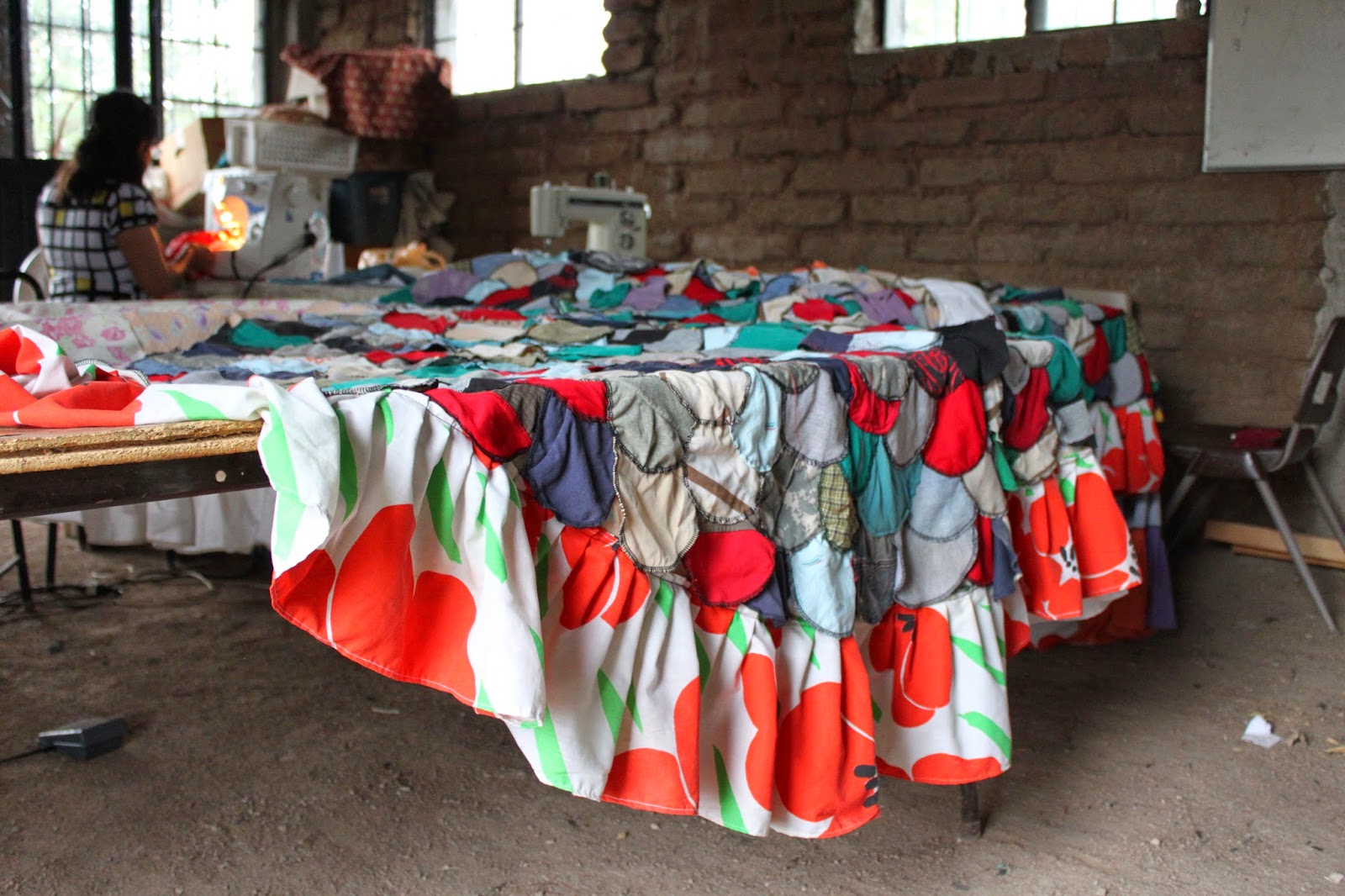
we sewed an enormous mexican folkdance skirt...


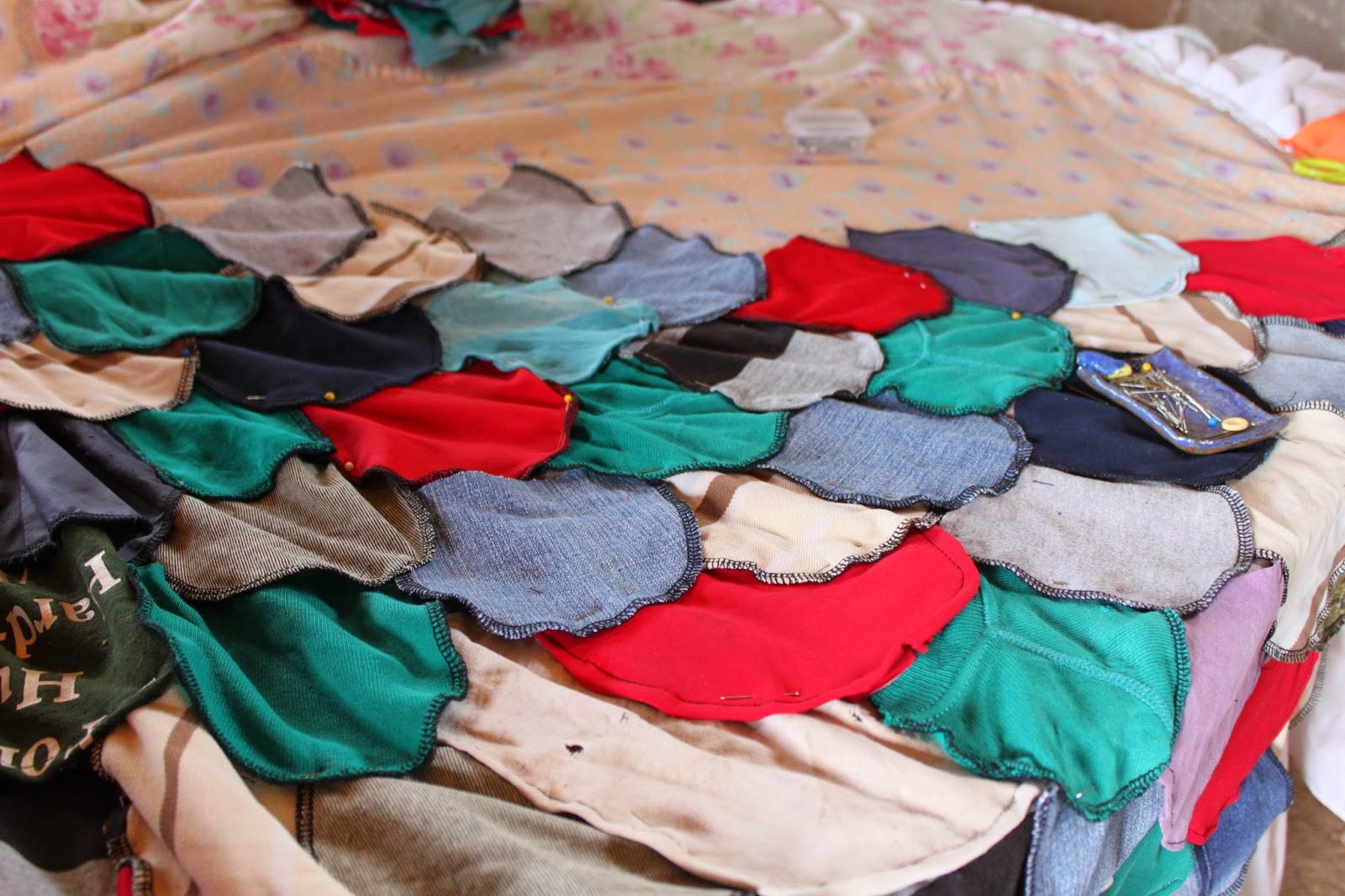
we cut up the clothes we collected from the desert, pinned them, and began to sew...in the final days working until we were squinting to see!


We collaborated with the folks at the rehabilitation center, CRREDA....

Ruben and Mickey.

and recorded interviews of their stories about life on the US-Mexico border...

Lola and Vanessa

and finally, we celebrated! We danced, we played music, we shared our experiences and our thanks for this amazing time to come together and create these works of art.

We present: the "Two Sisters/Las Dos Hermanas" - 2 Sister quilts in the form of traditional Mexican folk dance skirts. We started with one humongous skirt and I kid you not-- ONE DAY before the celebration cut it into two still-gigantic skirts.

The creators of "The Two Sisters/Las Dos Hermanas", from left: Ana Flor Adams, Miriam Maldonado & family, Maria Gabriela Marcos Santiago, Juana Martinez & family, Cleotilde Miss Vasquez & family, Jose Baltierres, Juan Rivas Hurtado, Jesus Marcos Santiago, Martin Galvar, Rosalinda Sagaste Chavez & family, Juan Vargas, Jesus Hernesto Dessens Velarde, Juna Rosales Muller, Miguel Angel Munguia Valenzuela, Ernesto Franco, Aracely Gonzalez Marquez, Juan Cayetano Marcos Santiago, Jocabed Gallegos, Maria Vicenta Santiago Isabel & family, Maribel Ruiz & family, Ruben Miranda. (Not pictured: Trinidad Anguamea Brasil, Ada Gonzalez & family, Melissa, Laila Rosales Muller, Vanessa Teran, Pedro Reyna Gomez, Maria "Lola" Dolores, Rigoberto Noperi Hernandes, Gabriela Garcia, Hector Hortega.)


The Sister on the left is completely finished, and will return with Juna to Ojai to be shared. The other Sister will stay in Agua Prieta, where the sewing group at DouglaPrieta wishes to complete it! 

Gabi chair-modeling the almost-complete falda.
The Two Sisters getting ready for the big night.

We hope to track the stories of the Two Sisters as each one travels, is shown, and is danced in on both sides of the border. In this way, we can also symbolically track the experience of families divided by borders, as they are parted and reunited over time.

We experienced an outpouring of joy at our celebration as each participant stood up to introduce themselves and share the story of how these quilts came to be. As the night went on, we feasted on Chicken Tinga tacos and pineapple juice lovingly prepared for days by the women of DouglaPrieta.

And we danced. The finished skirt was worn by woman after woman, girl after girl, as some of the more experienced dancers showed us how to work a falda.


Borders are places of division. They are also places where two things meet: places of coming together. As the project moves forward, we come back to the US with amazing new friends and a new experience of the kinds of connection that are possible between our two countries.

SO many people were involved in creating these Sisters. From the sewing bees in Ojai, Portland, and Agua Prieta, to the funding from friends and family all over the country, to the loan of a camera, to the ride to the airport shuttle, to the messages of support from so many. In particular we wish to thank the folks at Frontera de Cristo, DouglaPrieta, and CRREDA, for keeping us fed, sheltered, and in the right places, and for whole-heartedly diving in to participate.

Stay tuned. We have a video to edit, quilts in process, workshops on the horizon...and we can't wait to share them with you!

wow,
Juna & friends

Saturday, August 16, 2014

It's On


We're in the thick of it! Every morning we gather to work with the migrants' clothes -- washing, cutting, pinning and sewing. We've also been hard at work eating snacks (pineapple with chamoy sauce, homemade tamales, chiltepin peppers, sweet membrillo, jujubes, you know).

In all, there are about 10 of us sewing at DouglaPrieta Trabajan. Lots of kids come and help too.

The DouglaPrieta power team: Trini, Pedro, Cliotilde, Laila, Ada Lizet, Miriam, Rosalinda, Maribel & the girls, Juana, Juna, and Ada. Not pictured: Vanessa, Vicenta, and Vicenta's amazing kids!

When we first gathered two weeks ago, we discussed different designs we wanted to make using the clothes. We threw around quilt design ideas-- the emblematic volcano that lies east of Agua Prieta, footprints to represent the migrant trails, the Mexican flag. 

After one person had the idea of making new clothing from the migrant's discarded clothes, our task became clear: create a falda folklórica, or a traditional Mexican folk dance skirt. This kind of thing: 

The traditional folk dance costume of Jalisco.

Every region of Mexico, as well as parts of the United States and Central America, has a distinct costume, music, and style of folk dance. It made sense to the group to make a skirt because they are "very Mexican" and "represent a celebration of life". The falda folklórica's liveliness, sense of pride, and context would be in direct opposition to the material we would use to create one.

We decided to first create the skirt from old sheets, then cover it with pieces of the clothing. 

Aww. Laila was lovely our skirt-model.

The power team whipped out this skirt in no time. Now we are pinning & sewing up a storm to try to get all the pieces of clothing on before our ending celebration on Wednesday...crossing our fingers. We are hoping to have Miriam's daughter, who dances baile folklórico, show us how it's done.


We also continue to happily work with CRREDA, the rehabilitation center here in town. The afternoons are spent embroidering on the clothes with them, recording interviews, and sometimes playing unexpected baseball.

Our little outdoor spot at CRREDA.

It was such a treat to have both Laila and Vanessa come to help sew, take fotos, fold paper cranes for kids, and wander the streets at night in search of tasty food. People keep asking about them -- "when is she coming back?"

In other news, I tried cabeza for the first time (essentially cow cheeks). Verdict: delicious, and grateful they didn't tell me what it was until after I finished.

Hasta soon,
Juna & friends